
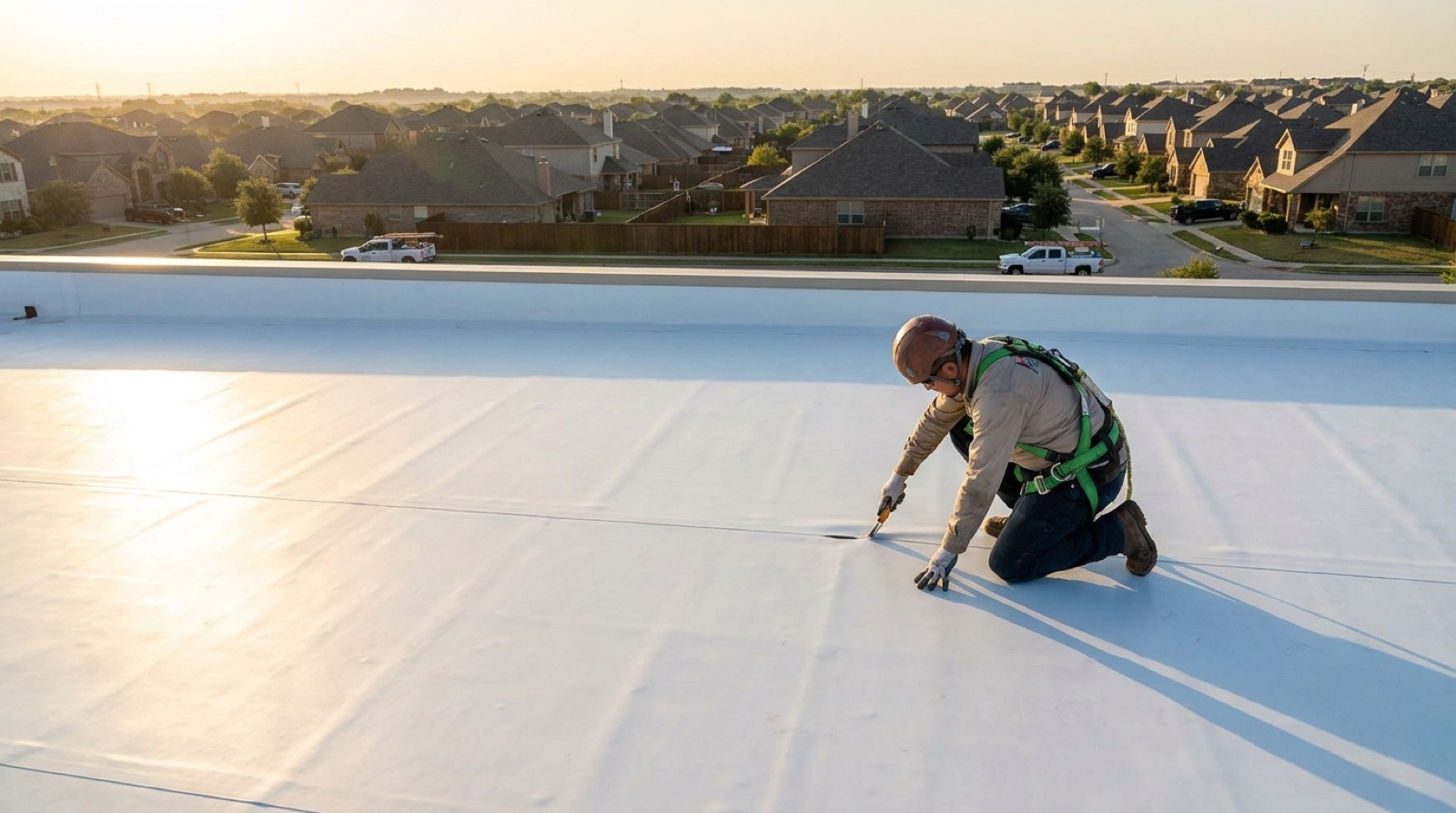
TPO is the default choice for most low slope commercial roofs in Hutto, and for good reason. The white membrane reflects a large share of the solar load, the seams are heat welded rather than glued, and a properly installed system lasts 20 to 25 years in Central Texas conditions.
If you own or manage a retail strip, warehouse, office building, or restaurant along US 79 or in the industrial areas off FM 685, TPO is probably the system quoted to you. Here is what that quote actually buys.
What TPO Is and How It Goes Down
TPO stands for thermoplastic polyolefin. It is a single ply membrane, usually 45, 60, or 80 mil thick, rolled out in sheets across the roof deck.
The critical detail is the seams. A hot air welder fuses adjacent sheets into a single continuous surface, which is stronger than the membrane itself and does not degrade the way adhesive seams do.
Underneath the membrane sits insulation board, typically polyiso, which carries the R value and creates the slope needed to move water toward the drains. The whole assembly is either mechanically fastened to the deck or fully adhered, depending on wind uplift requirements and the building code review.
The three attachment methods
- Mechanically attached: screws and plates through the membrane at the seams. Fastest and cheapest, best for large warehouse spans.
- Fully adhered: bonding adhesive across the entire field. Smoother appearance, better wind performance, higher labor cost.
- Ballasted: loose laid with stone on top. Rare on newer Williamson County buildings because of the added dead load.
Why TPO Fits the Hutto Climate
Summer roof surface temperatures in Hutto regularly clear 150 degrees on a dark membrane. A white TPO surface can run 50 to 70 degrees cooler, which pulls real money off the cooling bill in a building with rooftop HVAC units.
That reflectivity also slows down the thermal cycling that opens seams and cracks flashing. Less expansion and contraction means fewer service calls.
Hail is the other Texas factor. TPO does not dent like metal, but a heavy spring storm can bruise or puncture the membrane, especially at 45 mil. We recommend 60 mil minimum for any building in Hutto, Round Rock, or Taylor, and 80 mil if the roof carries a lot of foot traffic or equipment.
After a hail event, the damage is often invisible from the ground. A documented post storm roof inspection is what turns a suspicion into an insurance claim.
TPO Compared to Other Flat Roof Systems
| System | Lifespan | Best For |
|---|---|---|
| TPO | 20 to 25 yrs | Most Hutto commercial roofs, heat reflection |
| EPDM | 20 to 30 yrs | Cooler climates, complex penetrations |
| PVC | 20 to 30 yrs | Restaurants, grease exposure |
| Modified bitumen | 15 to 20 yrs | Small roofs, heavy foot traffic |
EPDM is a black rubber membrane and performs well, but the dark surface works against you in a Texas August. PVC costs more than TPO and earns that premium mainly where kitchen exhaust puts grease and oils on the roof.
If your building has a mix of low slope and steep slope areas, the two systems get specified separately. Our commercial roofing work across Hutto and Georgetown often involves a TPO field with metal or shingle accents at the entrances.
What a TPO Project Actually Involves
Start with the deck. If the existing roof has wet insulation, a tear off is required, because covering saturated board traps moisture and voids most manufacturer warranties.
A core sample tells us how many layers are already up there. Texas code generally allows two roof systems on a structure, so a third layer means full removal regardless of condition.
Drainage gets solved next. Ponding water that sits more than 48 hours after rain shortens membrane life and is a common warranty exclusion, so tapered insulation or added drains often go into the scope.
Then the details: curbs, pipe boots, scuppers, and the perimeter edge metal. Most flat roof leaks start at these transitions rather than in the open field, which is why detail work is worth paying for on a low slope roofing project.
Budget and Lifespan
Commercial TPO in the Hutto and Pflugerville market generally runs in the range of 7 to 14 dollars per square foot installed. The spread comes from tear off volume, insulation thickness, roof access, and how many penetrations have to be flashed.
Manufacturer warranties run 15, 20, or 30 years depending on membrane thickness and whether the installer is certified. Read what the warranty covers, because material only coverage leaves you paying labor.
Keeping the Roof Alive
TPO fails at the details long before the field membrane wears out. Twice yearly checks, drain clearing after storm season, and prompt repair of punctures from HVAC service work are what get you to year 25.
Building a scheduled maintenance plan also preserves the paper trail your warranty and your insurer will ask for. On an aging membrane that is still watertight, a reflective coating system can add 10 years for a fraction of replacement cost.
Getting an Honest Assessment
Not every flat roof needs replacing. Sometimes the answer is repairing 200 square feet of failed seam and correcting a drain.
We inspect commercial roofs across Hutto, Taylor, Round Rock, and the rest of Williamson County and give you the core sample results in writing. Get in touch for a quote and we will tell you what the roof actually needs.