
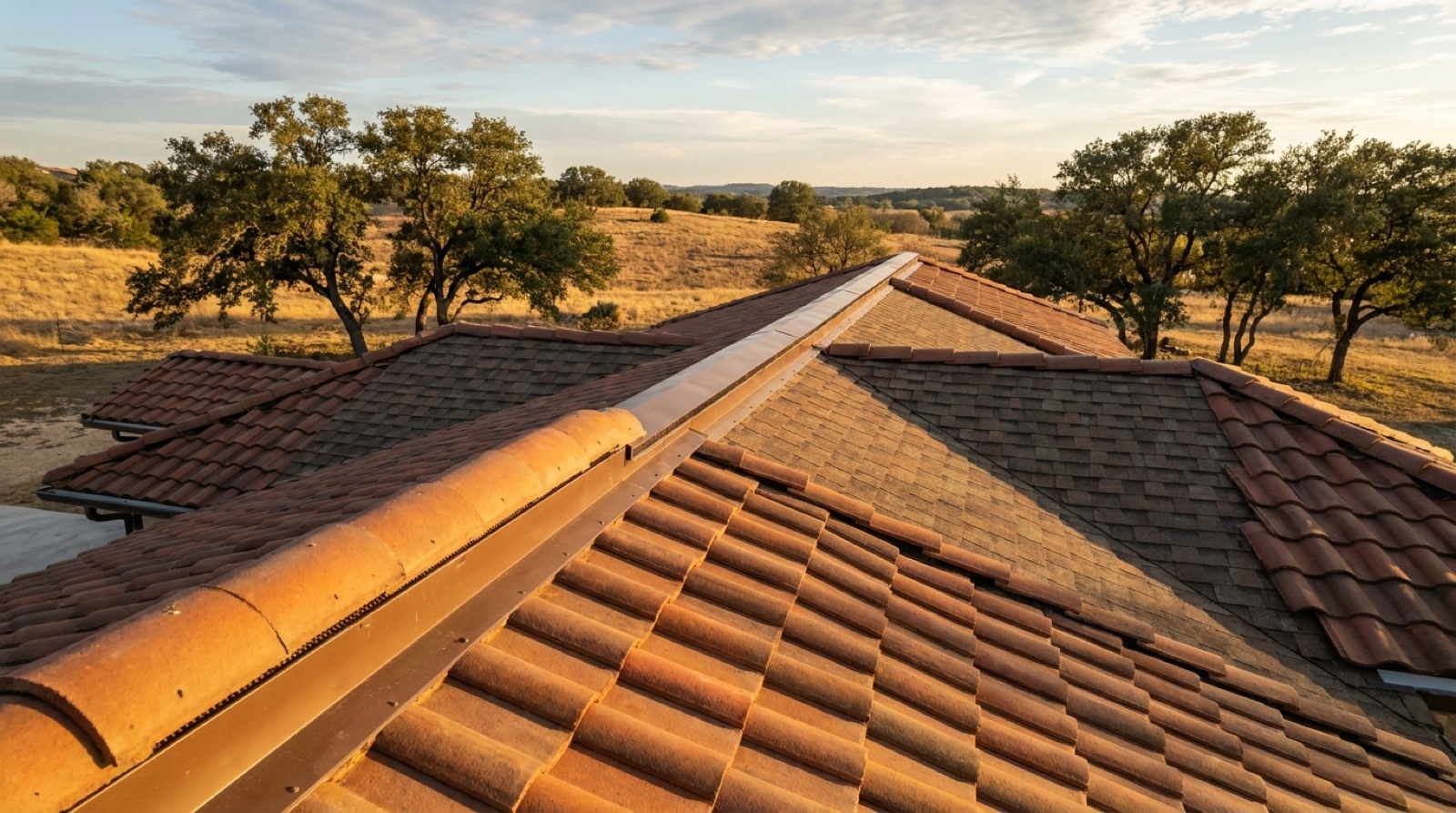
A poorly ventilated attic in Hutto can pass 150 degrees on an ordinary July afternoon. That heat bakes shingles from underneath, strips years off their service life, and pushes your cooling bill higher every month it goes unaddressed.
Ventilation is the least expensive part of a roof system and the part most often shortchanged. Getting it right protects everything above and below it.
What Attic Ventilation Actually Does
A working system pulls outside air in at the eaves and pushes it out at or near the ridge. Warm air rises and exits, and cooler air follows in behind it.
That continuous exchange does two jobs. It sheds heat in summer and carries water vapor out during cooler months.
Neither job is optional in Central Texas. We get punishing sun for five months and enough temperature swing the rest of the year to condense moisture on cold framing.
Why Hutto Attics Take a Harder Beating
Williamson County summers run long. Surface temperatures on dark asphalt shingles regularly pass 160 degrees, and the decking underneath holds that heat well after sunset.
Many newer subdivisions across Hutto, Round Rock, and Pflugerville were built tight, with radiant barrier decking and deep blown insulation. Tight construction is excellent for efficiency and completely unforgiving when airflow gets blocked.
Add our habit of dropping from a 100 degree afternoon to a 40 degree morning inside the same week. Those swings create condensation cycles that slowly soak sheathing.
What Trapped Heat Does to Shingles
- Asphalt binder softens and its oils cook off early, so granules shed and the surface goes brittle
- Decking dries, shrinks, and loses nail grip, which shows up as popped fasteners and wavy roof planes
- Manufacturer warranties commonly exclude any failure traced back to inadequate ventilation
That last point catches homeowners off guard. A 30 year shingle installed over a stagnant attic can fail in half that time with no warranty recourse, which is worth knowing before you compare shingle options for a Texas roof.
Moisture Is the Quieter Problem
Heat damage is visible from the driveway. Moisture damage stays hidden until a ceiling stains.
Every shower, dishwasher cycle, and load of laundry sends water vapor upward. With no exhaust path, that vapor meets cool sheathing overnight and condenses on it.
After a few seasons you get dark staining on the underside of the deck, matted insulation that no longer performs, and mold along the rafters. Bath fans that dump into the attic instead of venting through the roof accelerate all of it.
If you have already seen brown rings on a bedroom ceiling with no storm to blame, ventilation belongs near the top of the suspect list, ahead of the leaks that would call for targeted repair work.
How Much Ventilation You Need
Code uses a simple ratio. You need one square foot of net free vent area for every 300 square feet of attic floor when intake and exhaust are balanced.
Net free area is not the same as the physical size of the vent. Screens and louvers cut the usable opening by roughly half, and every manufacturer publishes that rated figure.
| Attic floor area | Net free area needed | Intake / exhaust split | Approx. ridge vent |
|---|---|---|---|
| 1,200 sq ft | 576 sq in | 288 / 288 | 16 linear ft |
| 1,800 sq ft | 864 sq in | 432 / 432 | 24 linear ft |
| 2,400 sq ft | 1,152 sq in | 576 / 576 | 32 linear ft |
| 3,000 sq ft | 1,440 sq in | 720 / 720 | 40 linear ft |
Ridge vent figures assume roughly 18 square inches of net free area per linear foot. Check the spec sheet for the product actually on your roof.
Intake and Exhaust Have to Be Balanced
More exhaust is not better. When ridge vents outpace soffit intake, the system pulls makeup air back down through the nearest opening or straight out of your living space.
Installers call that short circuiting, and blocked soffits are the usual cause. Insulation stuffed into the eaves during an energy upgrade seals off intake without anyone noticing.
Mixing exhaust types creates the same fight. A ridge vent paired with powered fans or box vents on the same roof plane will work against itself.
Common Ventilation Types
| Type | Location | Best suited to |
|---|---|---|
| Continuous ridge vent | Along the ridge line | Most pitched Hutto roofs with open soffits |
| Static box vents | High on the field | Cut up roofs with short ridges |
| Wind turbines | Upper slope | Exposed lots and older homes |
| Solar powered fans | Upper slope | Attics with limited ridge length |
| Soffit or fascia intake | Under the eaves | Every system, without exception |
Signs Your Attic Is Not Breathing
- The attic still feels like an oven at 9pm in August
- Upstairs rooms run 8 to 10 degrees warmer than downstairs
- Rusted nail points showing through the underside of the deck
- Flattened or discolored insulation near the eaves
- A musty smell when the attic hatch opens
- Shingles curling or losing granules well ahead of their rated age
Any two of those together justify a look. A professional attic and roof evaluation measures actual vent area rather than guessing from the curb.
Fixing It
Corrections are usually modest. Clearing blocked soffits, adding baffles, extending ridge vent, and rerouting bath fans through the roof handle most Hutto homes.
Ventilation is cheapest to correct during a tear off, when the ridge is already open. If your roof is nearing the end of its life, fold the fix into the replacement scope instead of paying for access twice.
For roofs with years left, ventilation work pairs naturally with seasonal maintenance visits that also catch flashing and sealant issues. Either way, the sooner airflow is restored, the more shingle life you keep.
Not sure what you have up there? Get in touch for a straight answer and a quote anywhere in Hutto, Taylor, Georgetown, or the rest of Williamson County.