
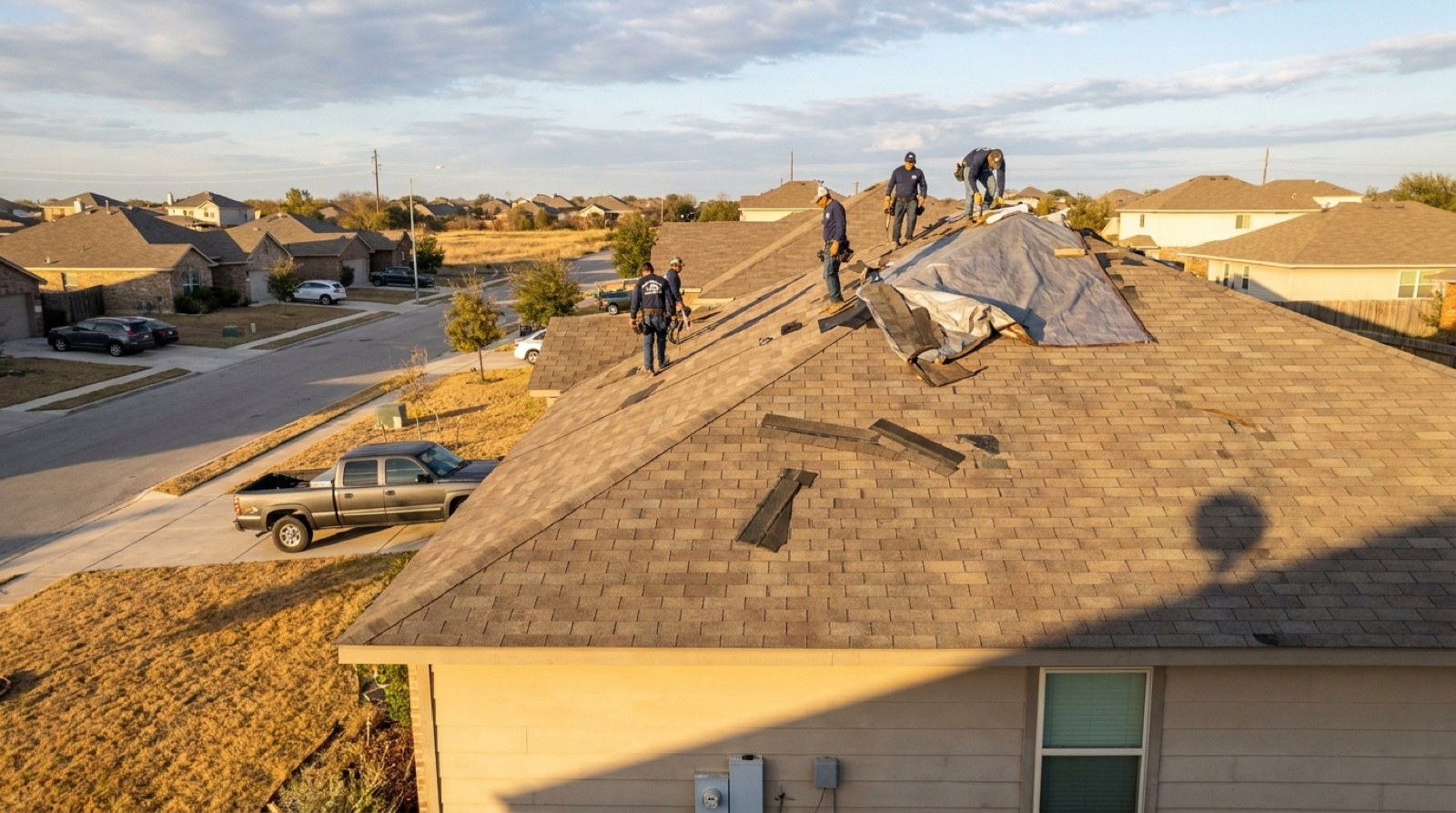
Most roof problems announce themselves long before water hits your ceiling. The trick is knowing what to look at and how often.
Here is what actually signals damage on a Hutto home, in the order you are likely to notice it.
Signs You Can See From the Ground
You do not need a ladder to catch most early warnings. A slow walk around the house after a storm will tell you a lot.
- Missing or lifted shingles. Central Texas wind gusts pull tabs loose, and one gap exposes the deck underneath.
- Dark patches or streaks. These often mean the protective granules have worn off and the mat is exposed to sun.
- Sagging rooflines. Any dip or wave in the ridge points to a structural issue and needs attention right away.
- Debris in the yard. Shingle fragments on the lawn after wind came through are pieces of your roof, not the neighbor's.
- Damaged flashing. Look at chimneys, vents, and where a second story meets a lower roof. Rust or separation there is a leak waiting to happen.
Check Your Gutters
Gutters collect the evidence. After heavy rain, look for a sandy buildup at the downspout outlet.
Those granules are the shingle surface washing away. A handful after a hailstorm is normal for a newer roof, but steady accumulation means the surface layer is failing.
While you are there, check that the gutters themselves are still pitched correctly and firmly attached. Sagging sections dump water against the fascia and rot it out, which is why gutter work and roof work usually get handled together.
Signs Inside the House
Interior symptoms mean water has already gotten past the roof surface. Do not wait on these.
- Brown or yellow rings on ceilings and upper walls
- Peeling paint near the top of interior walls
- Musty smells in closets or upstairs rooms
- Daylight visible through the attic decking
- Damp or matted insulation in the attic
The attic is the most useful place to check. Go up on a bright day with the lights off and look for pinholes of light, then go back during the next hard rain and look for active drips.
After a Hutto Storm, Look for These Specifically
Williamson County sits in a corridor that gets real hail. Spring storms roll through Hutto, Round Rock, and Taylor and leave damage that is easy to miss from the driveway.
Hail bruising looks like a dark, soft dent where the granules have been knocked off in a circle roughly the size of a coin. It does not leak immediately, which is exactly why people skip it and pay for it two years later.
Check soft metal first. Dents in gutters, vent caps, and your AC condenser fins confirm that hail was large enough to hurt shingles too, and that evidence supports a storm damage claim and repair before your filing window closes.
How Urgent Is It?
| What You See | Timeline |
|---|---|
| Active drip during rain | Same day |
| Sagging deck or roofline | Same day |
| Several missing shingles | Within a week |
| Cracked or rusted flashing | Within a month |
| Heavy granule loss | Schedule an inspection |
| Minor curling at edges | Monitor, inspect yearly |
Anything in the top two rows is an after hours emergency call, not a next available appointment. Water moving through a ceiling cavity ruins drywall, insulation, and wiring fast.
What Texas Heat Does to a Roof
Hutto summers push attic temperatures well past 130 degrees. That heat cycle bakes the asphalt binder, and shingles start curling at the corners or cracking across the tab.
Poor attic ventilation accelerates all of it. If your roof is under fifteen years old and already looks brittle, ventilation is usually the reason.
Repair or Replace?
Age and coverage area drive the answer. Damage confined to one slope or one section around a penetration is almost always a straightforward repair job.
When more than a quarter of the surface is affected, or the roof is past twenty years, patching becomes throwing money at a system that is done. At that point a full replacement costs less over the next decade.
Two things push toward replacement regardless of area: rotted decking and repeated leaks in different spots. Both mean the underlayment has failed broadly.
Get It Looked At Before It Spreads
Twice a year is the right cadence for Hutto homes, once after spring hail season and once before winter. A scheduled professional roof evaluation catches nail pops, lifted flashing, and sealant failure while they are still cheap fixes.
Homeowners across Hutto, Pflugerville, Georgetown, and the rest of Williamson County call us for exactly this. If you spotted something on this list, reach out for a free quote or call (512) 555-0150 and we will take a look.